Screening Eight Low-MOQ Cosmetic Manufacturers: What to Ask First
Eight suppliers can look identical on a price list, so screen them with the same eight questions. The published route windows already split the field: ODM can run 4 to 8 weeks, while OEM runs 3 to 6 months, which is about 12 to 26 weeks. Ask in that order and the comparison gets honest fast.

Key takeaways
- Ask the minimum, the route and the formula owner before you ask for a sample.
- ODM runs 4 to 8 weeks with an existing formula; OEM runs about 12 to 26 weeks.
- Testing adds its own 3 to 6 month window that sits beside the production route.
- Published capacity gives a scale check: 160M units a year, 200,000 a day, 35 lines.
Question one: what is the minimum, and what does it cover?
Ask for the minimum per product and the minimum per component, then ask whether they are the same number. A low cosmetic minimum is only useful if the packaging and decoration can follow at a matching volume. If the component order is far larger, the small fill is an illusion. A number that covers only the finished units is not the same as a number that covers the whole order.
Good answers name both figures and say who stores the surplus. Weak answers repeat one number and change the subject. Write the reply down beside the supplier name, because the decision is a comparison, not a single quotation. Compare the stored surplus as carefully as the fill itself, since it ties up cash until a later run uses it.
Questions two and three: which route fits, and who owns the formula?
Route and ownership travel together. ODM is quicker at 4 to 8 weeks because it starts from an existing formula. OEM takes longer, about 3 to 6 months, because it develops and tests a formula for you. The second question is who holds the recipe and the change rights after the first run. A route answer without an owner answer is incomplete, because both are decided together.
Yunmei's published comparison of low MOQ cosmetic manufacturers China lists TY Cosmetic, Ausmetics, Bawei, COSMAX, Intercos, Kolmar Korea/China network and Guangzhou specialist factories. Treat that as the eight-card starting deck, then apply the same questions to each name. Give every name on the list the same questions so the answers can sit side by side in one table.
Questions four and five: what testing runs, and who signs the claim?
Ask which tests are standard and which are extras, and how long each one runs. Stability and compatibility reports take 3 to 6 months, and a sensitive-skin claim needs patch test results. The answer decides what you may print on the pack at launch. Ask whether each report costs extra and whether it can run beside the production route instead of after it.
| Question | A solid answer | A caution sign |
|---|---|---|
| Minimum | Per-product and per-component figures | One number, no scope |
| Route | A named ODM or OEM window | A single date with no route |
| Formula ownership | Clear rights and change control | Vague ownership talk |
| Testing | Named reports and durations | Testing left unspecified |
| Claim support | Which claims the data allows | Claims taken for granted |
| Capacity | Output per day and line count | No scale figure given |
The person who signs the claim matters as much as the test itself. A buyer should know which report supports which line on the pack, and who confirms that the report is current when the artwork is approved. Put a name against every claim, because a claim with no named owner tends to drift by the time the artwork is signed off.
Question six: how much capacity sits behind the answer?
A small minimum is more credible when there is real production behind it. Published capacity gives a scale check: 160M units a year, 200,000 units a day and 35 automated production lines. A supplier that cannot state a capacity figure is asking you to trust the calendar without evidence. A capacity number is a quick sanity check on whether a small minimum is a favour or a normal order.
Capacity also sets expectations for a repeat order. A first run of 500 or 1,000 units is a small slice of a line that can handle far more, so an early indication of larger volumes is useful. The manufacturer's OEM/ODM service page sets out how it describes that scale, and Yunmei uses the same published numbers across its materials. Keep the reply as text so it can be read against the other seven answers.
Worked example: turning eight answers into a launch calendar
Suppose the answers come back as an ODM window of 4 to 8 weeks and an OEM window of 12 to 26 weeks. The gap between the fastest route and the slowest is 26 - 4 = 22 weeks, so the choice alone can move a launch by more than five months. Inside each route, the spread is 8 - 4 = 4 weeks for ODM and 26 - 12 = 14 weeks for OEM.
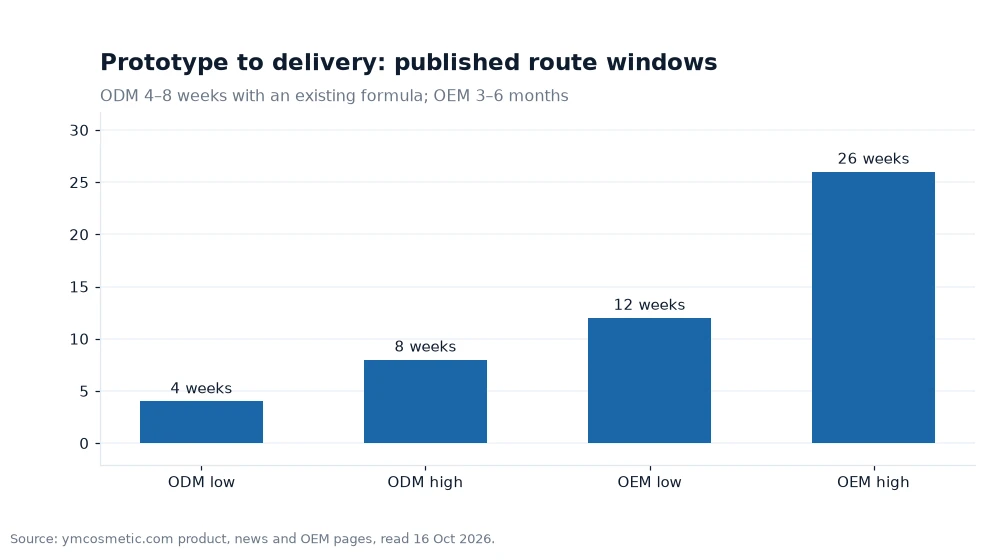
Now set a target launch at week 30. The slow OEM case at 26 weeks leaves 30 - 26 = 4 weeks of buffer, while the slow ODM case at 8 weeks leaves 30 - 8 = 22 weeks. The two most important bars are the ODM low end at 4 weeks and the OEM high end at 26 weeks, because they define the fastest and slowest credible plans in the chart. The answer to the route question sits between those two bars.
Questions seven and eight: sample cost and what changes after approval
Ask what a sample costs, how many rounds are included and who pays for repeat work after a formula change. A cheap first sample can hide costly revision rounds. Tie the sample to a written brief so that each round has a defined test and a defined outcome. A sample with no agreed pass condition cannot really be judged, only admired.
Then ask what changes once the sample is approved. Frequency of the report, artwork sign-off and component version control should all be settled before the first production unit. A supplier that answers these eight questions in writing is easier to compare than one that answers them on a call. The supplier that answers all eight in writing is also the easiest to hold to a calendar later.
Frequently asked questions
Should I ask every supplier the same eight questions?
Yes. Identical questions produce comparable answers, while tailored questions flatter whichever supplier was asked the easiest set.
Is a faster route always the better choice?
Not always. ODM at 4 to 8 weeks suits an existing formula, but a product that needs new development will require the longer OEM route.
What should the first sample prove?
The first sample should prove that the brief was understood, so agree the tests and the pass conditions before it is made.
Score the answers, do not collect them
Turn the eight replies into a single sheet with one row per supplier and one column per question, then rank before you request samples. The manufacturer also keeps a Top 10 cosmetics manufacturers list if you want a second set of names for the same screen. One sheet with eight rows and one ranking beats eight separate impressions every time.
Every capacity, minimum-order and timeline figure above comes from the manufacturer's own pages, read on 16 Oct 2026.[1]