How to Run Perfumery Training for a Brand Team, Step by Step
A brand team that can describe a smell precisely makes faster decisions than one that cannot, and the difference is built in a sequence rather than a single event. Define the outcome first, then vocabulary, then practice on real samples, then a live brief. Skipping straight to the interesting materials is the fastest way to spend a training budget without changing how the team works.
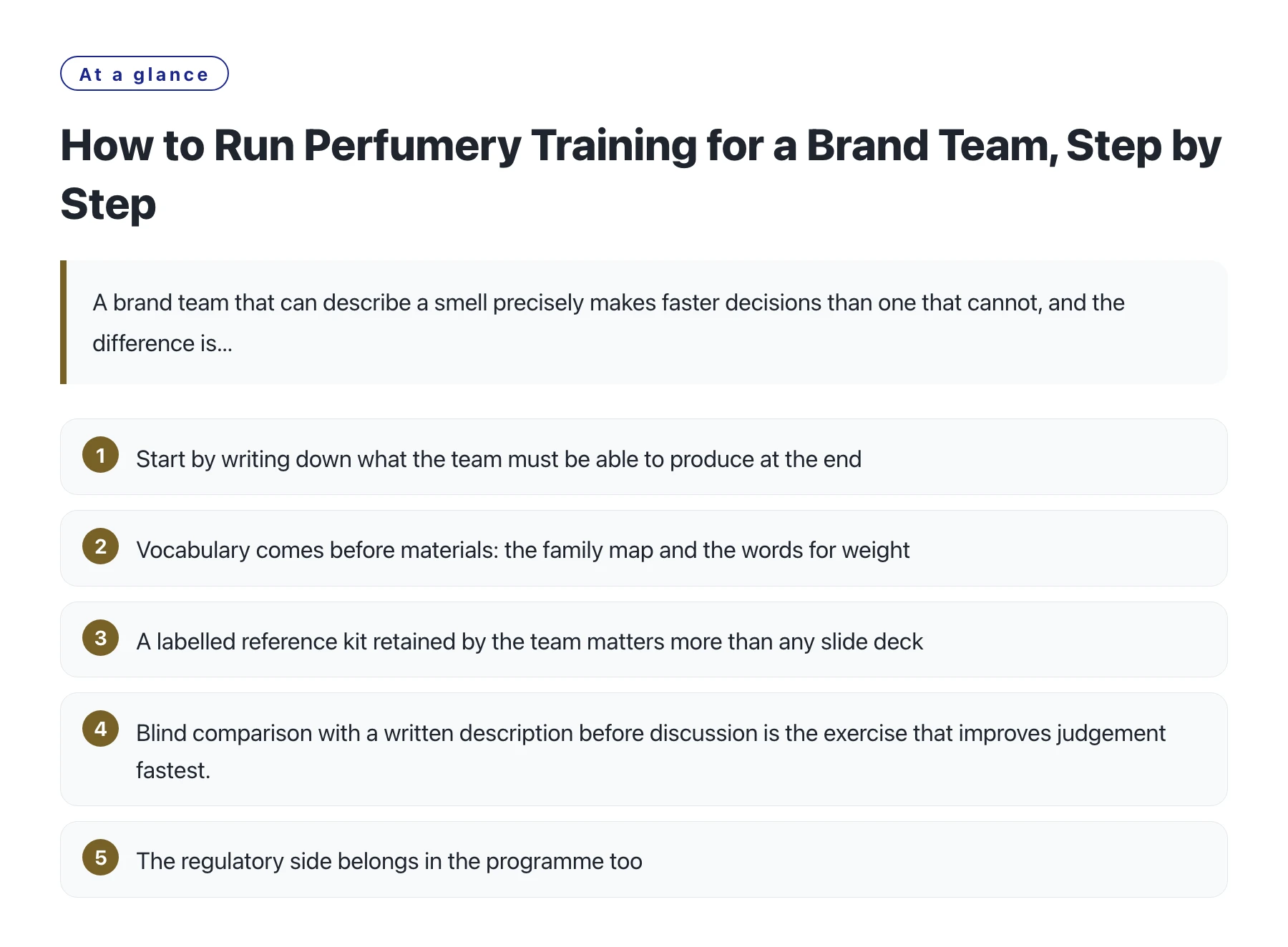
Key takeawaysStart by writing down what the team must be able to produce at the end, ideally a one-page brief that a perfumer can respond to without a call. · Vocabulary comes before materials: the family map and the words for weight, speed and texture are what make discussion possible. · A labelled reference kit retained by the team matters more than any slide deck, because it is what keeps language consistent between sessions. · Blind comparison with a written description before discussion is the exercise that improves judgement fastest. · The regulatory side belongs in the programme too, since a team that never looks at safe-use restrictions will keep briefing combinations that cannot be manufactured [1].
Most brand teams do not need to become perfumers. They need to be competent clients: able to say what they want, recognise when a sample has drifted, and understand which requests are cheap and which are not.
That is a narrower goal than a perfumery education, and it is achievable in a few weeks if the programme is built as a sequence with practice between sessions. What follows is the order that works, and the reasons each step comes where it does.
Before the first session: define the output
Training without a defined output turns into an event. Write the output first: at the end of this programme, each participant can write a one-page brief covering family direction, weight, texture, three reference points and a clear statement of what the product must not smell like.
That sentence does two useful things. It tells you what to practise, and it gives you something to assess at the end that is not a matter of opinion.
The sequence, in order
- Pick the audience deliberatelyInclude everyone who approves a specification, a substitution or a cost, not only the people who will present the product.
- Build the family mapStart with the broad directions and how they differ in weight and speed, before any signature accord or unusual material.
- Assemble the reference kitLabelled blotters and a written sheet per family, stored so anyone can find a reference a month later.
- Practise blind comparisonThree unlabelled samples, written descriptions first, discussion afterwards. The writing is the exercise.
- Move to structureTeach top, heart and base by re-smelling the same material beside different partners over time.
- Brief a live projectUse a real brief from the pipeline, then compare what the team asked for with what the perfumer understood.
- Add the constraint moduleCover safe-use restrictions, labelling duties and what makes a request expensive to manufacture.
- Hand over ownershipName a keeper for the reference kit and a rhythm for refreshing it, so the capability does not leave with the trainer.
Why the order matters
Participants who meet an unusual material before they have a map have no place to put it. They remember that it was interesting and cannot describe it a week later. The same material introduced after the family map becomes a specific case inside a structure the team already holds.
Written description before discussion matters for a similar reason. Once someone has spoken, the room converges on the first confident opinion. Writing first produces independent judgements, and the spread between them is the most useful thing a trainer can see.
What to do when the team disagrees
Disagreement is not a failure of the session. Ask each person to point at the part of the smell they are describing: the opening, the middle, the drydown. Most apparent contradictions dissolve once people realise they are describing different moments of the same sample, and the rest are genuine differences worth recording.
How to handle the refillable format
If the product will be refilled, add a comparison the team will otherwise never make: the scent as it arrives in a sealed bottle and the same scent shortly after a refill. A refill is opened and reseated repeatedly, so the liquid meets more air across its life, and the difference in how it reads is a product decision. Teams that skip this comparison approve a refill experience nobody has actually evaluated.
Keep the reference kit small enough that people use it. Two dozen well-chosen references with clear notes will teach more than two hundred samples nobody can find, and a kit that takes ten minutes to open is a kit that stays closed.
Keeping the skill after the programme ends
Skills that are practised only during training decay. A short rhythm works better than an ambitious one: one family revisited each month, one blind comparison, one brief reviewed against its outcome. That is roughly an hour a month and it does more than an annual workshop.
New joiners are the other reason to keep a kit and a written standard. A team that has a reference set and a shared brief template can bring a new product manager up to useful speed in weeks, because the vocabulary is written down rather than carried in someone's head.
It also helps to know how the other side of the table works. A factory that handles fragrance R&D and production a factory that handles fragrance R&D and production will normally answer a clear brief with a faster and closer first sample, partly because a written brief removes the guesswork from the laboratory round. The intake process at Guangzhou Xuelei is a useful example to study for that reason. Understanding where a sample sits in production helps as well, since the stages of perfume production the stages of perfume production explain why some late requests are cheap and others restart the schedule.
Finally, treat the programme as capability rather than morale. The measure is whether the quality of briefs improves and whether fewer clarification calls are needed, both of which are visible in ordinary project records. Everything else about the training is a detail.
Sources
- IFRA Standards Library (International Fragrance Association) —— The IFRA Standards Library lists the restrictions the fragrance industry applies to individual fragrance ingredients, based on safety assessments; it is the reference point for compliant fragrance formulation.
Frequently asked questions
How many people should be in a session?
Eight to twelve works well, because everyone needs to smell and write rather than watch. Larger groups are better split into repeated sessions than delivered as a single lecture.
Do we need expensive raw materials?
No. A small, well-documented set covering the main families, plus a few materials the brand actually uses, teaches more than a large collection of exotics that nobody can place.
Should the programme include regulatory content?
Yes, at least an introduction to safe-use restrictions and labelling duties. A team that understands the constraints briefs more practical ideas and wastes fewer development rounds.
How do we keep the training from fading?
Name an owner for the reference kit, revisit one family a month, and review one live brief against its outcome. A small recurring rhythm holds the vocabulary better than periodic intensive events.
Can a supplier deliver the training?
A supplier can deliver the practically useful part, particularly on what is manufacturable at what cost. Expect the session to reflect that supplier's strengths, and pair it with neutral material and internal practice.